What is Rainwater Harvesting and why is it Necessary?
Water is our most precious natural resource and something that most of us take for granted. We are now increasingly becoming aware of the importance of water to our survival and its limited supply, especially in dry season.
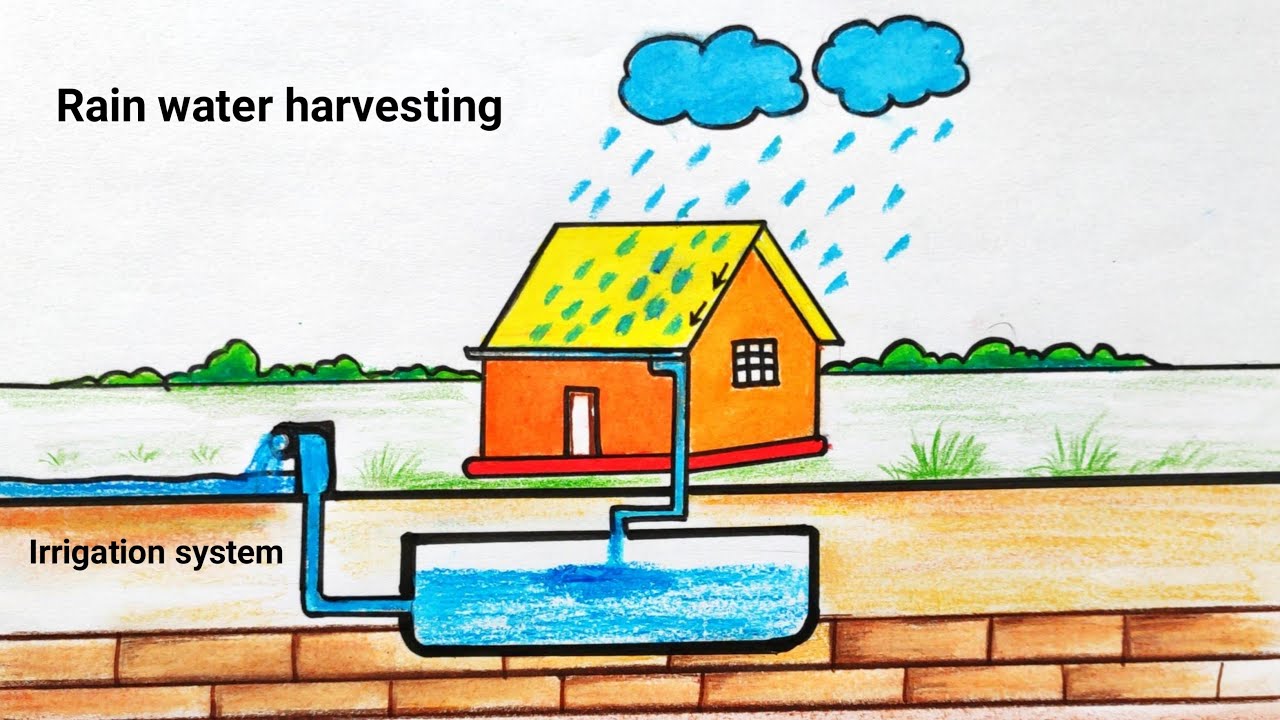
The harvesting of rainwater simply involves the collection of water from surfaces on which rain falls, and subsequently storing this water for later use. Normally water is collected from the roofs of buildings and stored in rainwater tanks. The water collected can be considered to be precious.
The collection of rainwater from the roofs of buildings can easily take place. All that is necessary to capture this water is to direct the flow of rainwater from roof gutters to a rainwater storage tank. By doing this, water can be and used for various purposes. It is possible to replace all or at least a substantial portion of your collected fresh water requirements by the capture and storage of rainwater from your roof. Being largely self sufficient in water supply is possible for a vast majority of households and buildings.
What are the Benefits in Rainwater Harvesting?
Economic Benefit
By capturing water directly, we can significantly reduce our reliance on municipal water supply. Collecting and using your own water can also significantly reduce your water bills.
Environmental Benefit
While the economic benefits outline the affordability of a rainwater system, there are environmental benefits that justify implementing such a system. By re-using rainwater, the demand is reduced on the regions already scarce water resources.
How much water can be harvested?
The amount of rainfall that can be effectively harvested is called the water harvesting potential. 25.4 mm (1 inch) of rainfall precipitation on one square foot catchment area can yield 2.36 liters of water. However, in practice, this volume can never be achieved since a portion evaporates and a portion may be lost to the drainage system, including the first flush. Therefore, we can only collect about 80 % of the rainfall.
The following is an illustrative theoretical calculation that highlights the enormous potential for rainwater harvesting. The same procedure can be applied to get the potential for any area, using the rainfall data.
Consider a catchment area of 100 sq. m. The average annual rainfall in Kathmandu is approx 1610 mm. In theory the catchment area is assumed to be impermeable and all the rain falling on it without evaporation, then in one year.
Area of plot
=
100 sq. m.
Height of rainfall
=
1610 mm
Volume of rainfall
=
Area of plot X Height of rainfall
=
100 sq. m X 1610 mm (1.610 m)
=
161.0 cu. m (161, 000 liters)
Assuming that only 80% of the total rainfall is effectively harvested
Volume of water harvested
=
161, 000 liters X 0.8
=
128, 800 liters.
The average daily drinking water requirement per person is 10 liters.
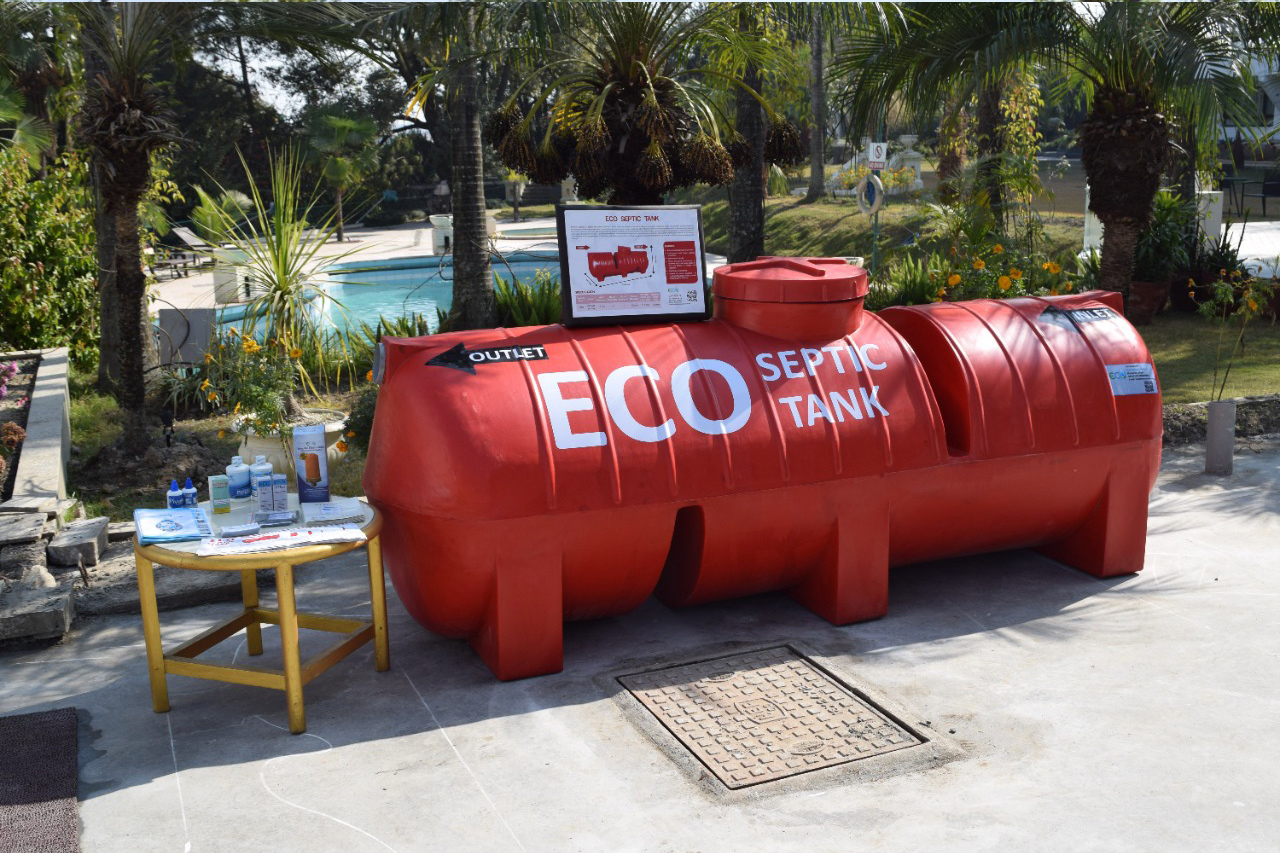
Faecal sludge management (FSM) is the collection, transport, and treatment of fecal sludge from pit latrines, septic tanks or other onsite sanitation systems. Fecal sludge is a mixture of human excreta, water and solid wastes (e.g. toilet paper or other anal cleansing materials, menstrual hygiene materials) that are disposed of in pits, tanks or vaults of onsite sanitation systems. Fecal sludge that is removed from septic tanks is called septage.
FSM is necessary in densely populated areas where a proportion of the population is not connected to a sewerage network, and the covering and rebuilding of pit latrines is not possible. This is the case in most urban areas in developing countries, but such services are also used in developed countries where sewerage systems are unavailable. FSM services are usually provided by formal and informal private sector services providers, local governments, water authorities and utilities. However, in many developing countries FSM services are often unavailable, or if they are available are often informal, unregulated, unhygienic and unsafe. This can lead to surface water and groundwater pollution, the spreading of pathogens into the environment and adverse public health impacts. It can also result in unreliable services with relatively high costs to the households which need them.
Faecal sludge collection services can be made available on a scheduled basis or on a call-for-service basis (also known as on-demand, on-request or non-scheduled services). The collected fecal sludge may be transported to treatment plants using a vacuum truck; a tank and pump mounted on a flatbed truck; a small tank pulled by a motorcycle; or in containers on a hand cart. Mobile or permanent transfer stations can be used to improve the efficiency of fecal sludge transportation by transferring the waste to larger tankers for haulage to treatment. The wider use of multiple decentralized sludge treatment facilities within cities (to avoid long haulage distances) is currently being researched and piloted.
The collected fecal sludge should preferably be processed at dedicated fecal sludge treatment plants, instead of being co-treated with sewage in municipal sewage treatment plants, unless these plants are able to take the additional load, and facilities to separate liquids and solids are available. A variety of mechanized and non-mechanized processing technologies may be used, including constructed wetlands, anaerobic digestion, and waste stabilization ponds. The treatment process can produce useful products such as treated effluent that can be used for irrigation. Another possibility is to use the treated fecal sludge after composting as a soil conditioner or for the production of biogas, charcoal, biodiesel, powdered industrial fuel and electricity. Historically, the term night soil was used for fecal sludge.
Some Videos Related to FSM:
SODIS (Solar Water Disinfection) is a simple water treatment method relying on solar electromagnetic radiation and temperature to inactive pathogens. SODIS capitalizes on the UV-A radiation of the solar electromagnetic spectrum to a germicidal effect. Additionally, infrared radiation raises the water temperature which has a pasteurization effect. Research has shown that SODIS is more efficient in water containing high levels of oxygen. In order to achieve maximum saturation of the water with oxygen, the bottles are filled up to three quarters and shaken for about 20 seconds before they are filled completely to the brim.
Although water supply coverage has increased remarkably in Nepal, not much attention has been given to improve the water quality. Recurring outbreaks of water borne diseases and high numbers of patients being admitted to hospitals with water borne disease ailments indicates a need to public health status via improving water quality. Additionally, the low income community are more vulnerable to such diseases and the subsequent economic repercussions. Considering the above mentioned factoids, it is essential to promote simple, low cost and effective water treatment options.
ENPHO started conducting research on SODIS in the year 2000 with support from EWAG/SANDEC of Switzerland. In the year 2003, ENPHO started promoting SODIS through its network of NGOs, municipality representatives and community groups. SODIS implementation strategy is divided into two approaches: Door to Door Monitoring approach and Awareness Package approach. As per the first approach, ENPHO conducted door-to- door SODIS promotion in Bishnumati corridor with collaboration of SANDEC/ World Vision International Nepal.
Additionally, between 2004 and 2005, ENPHO joined hands with Kathmandu Metropolitan City (KMC) and several NGOs to launch a campaign in Kathmandu. The campaign aimed to spread SODIS related messages amongst more than 50,000 households. Subsequently, more than 10,000 additional households used SODIS regularly as per the campaign. Mass education campaigns utilizing all forms of printed and electronic media as well as public exhibitions and hoarding boards helped spread the message regarding SODIS. Moreover, community mobilizers trained over 10,000 individuals, besides the individuals reached via the door- to- door monitoring approach, on the application of SODIS.
Furthermore, in 2006, ENPHO worked with various government agencies to institutionalize SODIS. ENPHO worked with the Ministry of Education and Ministry of Health for further promoting SODIS. Attempting to further scale up the program, ENPHO collaborated with governmental agencies such as Ministry of Health/District Public Health Offices (DPHO) and Municipalities to incorporate SODIS technology as part of their regular activities. Various training sessions were conducted, IEC materials were distributed and several hoarding board were set up for promoting SODIS. As per monitoring data, in the year 2006, 2375 regular SODIS users were recorded in Bhaktapur, Lalitpur, Kirtipur and Thimi municipalities. Regular monitoring and follow ups were done to ensure correct and sustained use of SODIS.
In 2008, ENPHO in coordination with UNICEF promoted SODIS in schools where a total of 6724 students were taught the specifics of SODIS technology and 123 local residents were given ToT on PoU technologies through mass media by UNICEF/DWSS in collaboration with ENPHO. Collectively, 13,980 individuals were trained in various training sessions which incorporated SODIS. In 2009, ENPHO started an investigation into the sustainable use of SODIS and explorations into new approaches. ENPHO joined hands with EWAG/SANDEC and conducted a sustainability study, as part of an international study to evaluate long term application of SODIS at grassroots levels.
ENPHO has continued to maximize the process of SODIS institutionalization and bring about positive health impact in various communities. Local stakeholders including government agencies have recognized SODIS as a simple, low cost, appropriate technology for drinking water treatment training courses. Due to simplicity and effectiveness of SODIS, communities are using the technology as an alternative method of drinking water purification. During all of ENPHO’s SODIS promotion activities, special attention has been given to the simplicity and effectiveness.
Decentralized Wastewater Treatment System (DEWATS) can be described as a low maintenance treatment system, treating small volumes of wastewater for reuse or discharge within National Standards. DEWATS generally treats domestic wastewater originating from individual or groups of dwellings, businesses or institutions that are located in close proximity to each other and the DEWATS site. Unlike conventional wastewater treatment plants, DEWATS promotes technologies that use natural processes and are simples in operation and maintenance. In DEWATS, natural treatment processes are achieved through methods that make use of physical principles combined with biological activities of microorganisms. Bacteria colonies in the treatment devices are generated from microbial populations that occur naturally in the wastewater.
The size of a DEWATS can range from individual onsite systems that serve one household or institution; to shared facilities that serve up to ten households or public/community facilities serving up to 2000 households. Since the distance between the point of origin and treatment of wastewater is small, elaborate collection systems and pumping equipment is avoided thereby reducing costs. This also allows for easier reuse of treated water which again makes the whole system cost efficient.
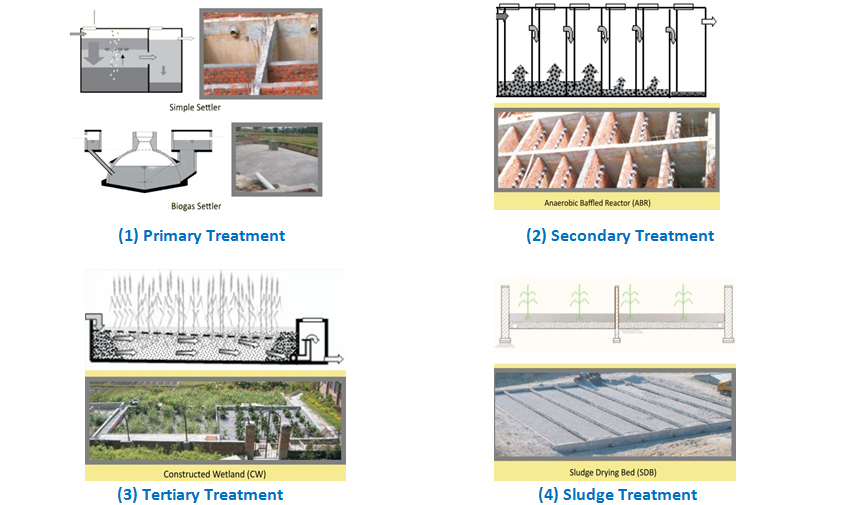
Typical DEWATS combine the following technical treatment steps in a modular manner.
(1) Primary Treatment
The primary treatment phase retains all settable solids and allow only dissolved solids to discharge.
In settler, sedimentation tank, septic tank or biogas settler.
Another type of primary treatment is sedimentation tank for collection and use of biogas generated from decomposition of settled organic particles.
(2) Secondary Treatment
Suspended and dissolved solids in the wastewater undergo anaerobic degradation due to contact with an active sludge blanket on the bottom of each chamber.
(3) Tertiary Treatment
It is the secondary and/or tertiary treatment phase and cleans the wastewater by biological conversion, physical filtration and chemical adsorption.
(4) Sludge Treatment
Sludge generated from primary and secondary treatment units can be dried applying on sand beds, which is also called sludge drying beds. De-sludging intervals can be set to coincide with the dry season in order speed up the drying process.
EXISTING DEWATS IN NEPAL
S.N.
Location Type
Year Built
1
Dhulikhel Hospital Hospital
1997
2
Dallu, Private House Domestic
1998
3
Kathmandu University Institutional
2001
4
ENPHO Laboratory Institutional
2002
5
Malpi International School Institutional
2002
6
Sushma Koirala Memorial Plastic &Reconstructive Surgery Hospital Hospital
2002
7
Kapan Monastry Institutional
2002
8
Private House at Dallu Domestic
2002
9
Septage Treatment, Pokhara Community
2003
10
Shuvatara School, Lamatar Institutional
2004
11
Surya Tobacco Industrial
2005
12
Private House, Bishal Nagar Domestic
2005
13
Sunga, Thimi Municipal
2006
14
Kirtipur Housing Community Community
2006
15
Kusunti Housing Community
2007
16
Ilam Polyclinic Hospital
2007
17
Sano Khokana Community Community
2008
18
Srikhandapur Community
2008
19
Monastry in Pharping, Dakshinkali Institutional
2009
20
Private House at Kirtipur Domestic
2010
21
Namo Bhudha Resort
2012
22
Thakuri Gaun Sub System
2009
23
Pipal Bot Sub System
2009
24
Srikhandapur Community Wastewater Treatment Plant
2008
25
Nala Community Wastewater Treatment Plant
2012
26
Panauti Wastewater Treatment Plant
2009
27
Chandeshwori Wastewater Treatment Plant
2009
28
Budole Wastewater Treatment Plant
2009
29
Landfill Site Wastewater Treatment Plant
2009
30
Gokarna Wastewater Treatment Plant(I)
2012
31
Gokarna Wastewater Treatment Plant(II)
2014
32
Gokarna Wastewater Treatment Plant (III)
2016
33
Kapan Monastry
2002
34
Satya Sai Sikshya Sadan
2014
35
School at Dallu
2010
36
Central Horticulture Center
2011
37
Neydo Monastry
2009
38
Kusunti Housing
2007
39
ICIMOD
2010
40
Ama Ghar
2010
41
Suvatara School
2004
42
Park Village Water Front Resort
2011
43
Hetauda Wastewater Treatment Kara Sub System
2009
44
Hetauda Waste Treatment Rapti II Sub System
2009
45
Hetauda Wastewater Treatment Rapti II Sub System
2009
46
Hetauda Industrial Wastewater Treatment Plant
2003
47
Bharatpur Wastewater Treatment Plant (C1)
2009
48
Bharatpur Wastewater Treatment Plant (C2)
2009
49
Surya Nepal Pvt. Limited (Staff Housing)
2005
50
Lumbini Medical College and Teaching Hospital
51
Sidhartha Childern and Women Hospital (AMDA)
52
Middle Marshyangdi Hydro Electric Power Station (Staff Quarter)
Waste management is one of the major challenges for developing countries like Nepal, where the waste generated is haphazardly dumped, is causing pollution to both surface and ground water sources. Consumption of contaminated water can cause various water borne diseases such as diarrhea, dysentery, typhoid, etc. The cases of water borne diseases are increasing, resulting in deaths of many children less than 5 years of age. Nonetheless, different technologies such as drainage systems, water treatment systems, sanitary landfill has been developed in various phases of time addressing these environmental and human health issues. But implementation of these technologies developed in the western countries demand huge investment and highly skilled man power mostly unavailable to developing countries. Therefore, 3 R Principal (Reduce, Recycle and Reuse) on waste management has been the most effective tool, providing ample opportunities to re-use of the waste as resources. Similar to woes of water resources, Nepals’ agriculture sector is also in grim situation. The excessive and continuous use of the chemical fertilizers for the higher production is not only deteriorating the soil fertility but also posing harm to human health. Instead, the use of natural fertilizers could best serve the need for sustainable farming and improve human health. In this context the concept of ‘Ecological Sanitation (EcoSan)’ has emerged as a solution to tackle both of these problems.
EcoSan
EcoSan is an environmental friendly sanitation technology, which acknowledges human urine and faeces as valuable resources for agricultural sustainability. Urine contains various elements such as nitrogen, phosphorus and potassium necessary for the plant growth. Human faeces also contains these elements though in lower concentrations along with organic matter essential for agricultural productivity. But unlike urine, faeces contains thousands of bacteria including pathogens. In this regard, in EcoSan toilets, urine and faeces can be collected separately for the use in agricultural field which is fruitful from both environmental and economic point of view. This makes EcoSan toilets different from the conventional toilets. Most of the EcoSan toilets being constructed at present are designed with two concrete chambers of equal volume for faeces collection and a plastic drum for urine collection. Normally, it takes six to seven months to fill one chamber for a family size of 5 to 6. Once one chamber is filled up with faeces, the second chamber is used. By the time this second chamber gets filled, the faeces collected in the previous chamber would be ready to be used as a soil conditioner. The time required to convert the faeces into soil conditioner ensures bacterial die-off. With an assumption of 1.5 L of urination from a person a day and a family size of 5-6 members, a container sufficient to collect urine for 10 days in average is used while constructing EcoSan toilet. The collected urine can either be used in agriculture or in compost preparation. The use of urine in compost increases degradation rate of compost and enhances its nutrient content.
Benefits of EcoSan
Use of NPK rich urine as a soil moisturizer.
Water conservation and low wastewater generation.
Decrease in monthly water bills and chemical purchasing cost.
Environmental and water resources conservation.
Limitations of EcoSan
Uncomfortable to use in the beginning as the design is different from the conventional toilets.
Reluctance in acceptance and use.
Lack of farming land limits the application of urine and faeces.